The EHS Buyer's AI Prefix Decoder
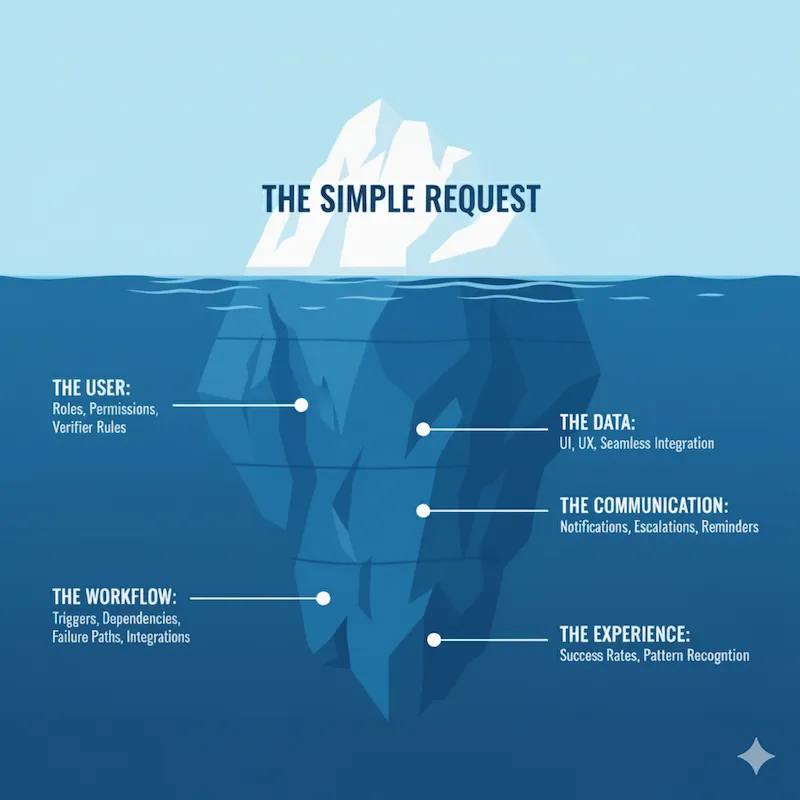
A vendor can change "cloud-based" to "AI-powered" on its homepage in an afternoon. Rebuilding the data model underneath takes years. Every AI prefix lives in that gap.


A vendor can change "cloud-based" to "AI-powered" on their homepage in an afternoon. Rebuilding the data model underneath — the schema that dictates how hazard reports connect to asset registries and HR records — takes years. So does building the machinery that lets a model act on that data inside a boundary someone can audit. Every AI prefix in EHS software marketing lives in the gap between those two speeds.
No regulator will settle what these words mean. The EU AI Act regulates what an AI system does. ISO 42001 (the international AI standard) certifies how the vendor manages it. The US Federal Trade Commission (FTC) can fine a vendor for a flatly false AI claim — its Operation AI Comply initiative has brought more than a dozen such cases since its launch in late 2024. All of that catches a lie about whether AI exists. None of it defines how much AI "AI-powered" has to contain, or how deep "AI-native" has to go. A vendor can build a chat window onto a ten-year-old database, call the result "AI-native," and stay well inside the law. The AI is real. It is just smaller than the word.
Inflated labels are not new — "mobile-first" was one. But "mobile-first" promised a screen. You could open it and judge it with your own eyes. An AI prefix promises architecture: what the database stores, what the model reads, what it is allowed to do on its own. None of that is visible in a demo unless you make the vendor show it.
That is what this decoder is for. It assigns each prefix a concrete, testable meaning. No vendor agreed to these definitions, and that is the point: put one in front of a vendor and they must accept it, replace it with a definition of their own — which can go straight into the contract, and the last section shows how — or wave the label away as "just marketing," which tells you the prefix carries no product capability at all. Whatever they do, the label stops being decoration and becomes the vendor's first specific claim.
Each entry below ends with a demo question. It tests a claim the vendor made on their own website — so it cannot be out of scope — and it asks to see a specific output in the software. Ask it in your next demo. Write down what the screen actually shows.
Why the Words Outrun the Product
The reason is cost. Adding an AI feature to an existing product is cheap: the vendor pays to connect to a language model (like the ones behind ChatGPT or Claude), sends it your incident description, and displays the answer. That is a real, useful feature — and it changes nothing about how the software actually captures or stores your safety data. The expensive part is rebuilding how the software captures that data. This means redesigning forms, migrating years of historical records, and rewriting how safety dashboards and compliance reports are built. The costliest part is building the safety controls and database logs that let an AI automatically change records, trigger notifications, and log every decision for future audits.
The vocabulary tells you almost nothing about the product, but it tells you exactly what claim the vendor is making. Hold them to it.
The Decoder
Six prefixes, three tiers. Each entry explains the real architecture behind the word, the exact question to ask in a demo, and the answer that exposes the truth.
Tier 1: The feature claims
AI-wrapped is the baseline reality for most products, though no vendor calls themselves this. It means the vendor took a traditional system and bolted a language model on top—a pattern often marketed as "AI-infused." In practice, it is usually just a text summarizer or a chat window that reads from the exact same database structure as before, with no underlying integration.
The question: "Turn the AI features off. Walk me through what is left."
The exposing answer: If what is left is the exact product you saw three years ago — same forms, same fields, same reports — the AI is just a wrapper. This is not always a dealbreaker. A good wrapper on a solid data model is better than a bad platform built from scratch. But you should pay wrapper prices for it, not new platform prices.
AI-powered means a few specific features use an AI model. It is usually just two or three things: summarizing an incident, a chatbot for your documents, or auto-suggesting a hazard category.
The question: "List every feature that uses AI. For each one, what data does it read, and is the model yours or a third party's?"
The exposing answer: Expect a short list and third-party models. An answer like, "Our AI reads the incident description and sends it to a third-party model" is completely fine, if the vendor says it directly. The red flag is a vendor who cannot produce the list. A team that actually built the features knows exactly where the AI starts and stops. You do not have to judge if the third-party model is good — let IT or security do that later. If the vendor needs to follow up with the exact model name and how data moves through the system, that is normal. But a vague "we use AI under the hood" that never turns into a specific answer is a warning sign.
Tier 2: The decision claims
AI-driven means the model influences your decisions. It gives you a risk score that ranks your sites, or a priority flag on an open corrective action. This is where the marketing claims start to matter. A bad AI summary just wastes a minute. A bad risk score leaves people in danger. For instance, if a prioritization model labels an unclosed corrective action for a cracked lockout-tagout (LOTO) switch as "low priority" because it misclassifies the word "switch" as minor facility maintenance, you will focus on checking fire extinguisher inspection tags in the main office while a technician works on a live circuit.
The question: "Show me one prediction and the raw event records behind it. Then show me what happens when a safety manager disagrees with the score — and whether that override is recorded."
The exposing answer: Watch out for two red flags. First, the vendor shows you the score but cannot show you the records behind it. This usually happens because they calculate the score in a separate analytics system and sync only the final number back to your database, leaving the safety application with no link to the actual audits or incidents that drove it. Alternatively, they are using a "black-box" model—one that calculates a score but cannot explain which specific hazards, like hot work or overdue inspections, carried the most weight. In both cases, they are asking you to make safety decisions based on a score you cannot verify. Second, the system does not track when a human corrects the AI. If the AI gets a risk score wrong and you fix it, the software must log that you overruled the machine. If the database simply overwrites the model's prediction with your correction, it deletes the AI's errors. This makes the model look retroactively perfect on paper. That is why you must ask to see the override log instead of trusting the vendor's accuracy statistics. You do not have to judge if the raw records are complete — hand them to IT before you sign. A follow-up call to produce them is normal. Never producing them at all is the red flag that matters.
There is a legal version of this question. It separates vendors who understand regulatory risk from those who just build features. If the AI scores workers instead of sites or equipment — like a behavior score tied to a named person — it likely falls under Annex III of the EU AI Act. This law classifies AI systems that monitor worker performance as high-risk. High-risk status forces the vendor to prove human oversight and provide technical documentation, starting in August 2026.
Vendors will try to use an exemption. They will claim their score is just "advisory" and a human always makes the final decision. Ask them to show you exactly where the human review is saved in the software, not just written in a policy document. If the system cannot record a human overriding the AI, the vendor does not have a real compliance position. If the vendor has no EU customers, this specific law does not apply. But the core problem remains: who besides you sees the evidence behind a score with a worker's name attached, and under what law, if not this one?
The law does not care what marketing prefix the vendor uses. An older platform that simply added an AI risk score to its existing database has the exact same legal exposure as a brand new platform. The law only cares what the AI does to a named worker. Ask this question to every vendor who shows you a score tied to a person. Ask if their compliance team has classified the feature under Annex III of the EU AI Act, and ask to see their documentation. A vendor selling a worker risk score who has not asked themselves that question is not behind on marketing. They are behind on the law.
In product strategy (specifically IBM’s design frameworks), AI-first means a product built from the ground up with machine learning as its foundation—designed to learn continuously, anticipate user needs, and adapt the system dynamically. In EHS vendor marketing, however, "AI-first" is almost always just an interface claim: a conversational chat window layered on top of old menus. It changes how you talk to the software, but it changes nothing about how the software reasons.
The question: "Reassign this open corrective action to a different site lead, start to finish, through the conversational interface. Then show me the same record in the classic form — does the manual path still exist, or did you remove it?"
The exposing answer: Two things to watch. First, if the conversational layer just opens the old form pre-filled and waits for someone to click through the same fields, the AI is a shortcut typed on top of the old product, not a new front door — that is AI-powered wearing a bigger word. Second, check whether the manual form still exists at all. A vendor who deleted it to force adoption of the chat interface has built a product that fails the moment a worker is in a high-noise work area with no reliable voice input, or the network drops. AI-first should add a way in. It should not remove the one that already worked.
Tier 3: The architecture claims
AI-native is the biggest claim, and vendors count on you accepting a shortcut for it. Structured safety events, intact timestamps, consistent hazard categories, field capture at the point of work — a well-run legacy platform can have every one of those with no AI in it at all. That data hygiene is the entry fee, not the claim. AI-native means the AI is the engine running the software, not just an assistant you ask for help. The system does not wait for you to run a report; it uses AI to trigger safety workflows and make decisions on its own, inside boundaries you can audit.
The question: "Log a new incident record in our trial account, not a demo script. Show me one workflow action the system initiates on its own based on that text. Where is the log that records why the AI took that action, and where do we configure the boundary that stops it?"
The exposing answer: Two failure modes. First, the automated action only triggers on their pre-loaded demo records, not on the new incident you just logged. This tells you the model is reading from an offline snapshot or batch export rather than the live database, so the "native" label describes the sales pitch, not the product. Second, the vendor cannot show the system executing a decision on its own, only displaying scores and summaries for a human to handle later. That is AI-driven with a heavier word attached, not AI-native.
One tell does not require you to be technical: ask them to change something in the live record on screen — a location, a hazard category — and watch whether the AI's next answer reflects the change within the same conversation. If the AI is still describing the old value, it was never reading live data to begin with.
A vendor who says "our model reads the text and automatically fills in specific fields (like the hazard category or location) after it is written" is describing a real technique for building the entry fee. It still leaves the real question open: once that data exists, does anything act on it, or does it just sit there, better organized than before? Ask to see the second part, not just the first.
One answer is worth listening to: "the AI can auto-close a corrective action below a set risk threshold, and every auto-closure is logged against the record it acted on." That is a real safety control, not a dodge. Test it. Ask to see the log of actions the AI has taken on its own, and how a supervisor reverses one. A vendor with no automated logs has no real background automation to show, no matter what the homepage says.
You do not have to decide whether the boundary is drawn in the right place — that is a risk call for your safety and legal teams, not a demo question. Your job in the room is narrower: does the AI touch live data, does it act inside the workflow, and is every action it takes recorded? If the vendor can only show you a diagram of where those boundaries would go, they have a plan. Not a product.
One test ties the tiers together: picture the AI switched off. An AI-wrapped product looks identical — nothing changed. An AI-first product still runs, just through the old menus, because the AI was only ever the front door. An AI-driven product also keeps running, but it degrades: the risk score and the priority flag disappear, and you are back to reading raw incident lists yourself — worse triage, not a broken tool. Only a genuinely AI-native platform breaks in a way that matters: not slower, not clunkier, but unable to do the job it was doing a moment before. If you can imagine the vendor's product working fine with the AI gone, the label was never true — and if you can only imagine it working worse, that tells you which tier you are actually buying.
AI-ready is different. It describes your organization, not the vendor's software—and it matches the core rule of enterprise data: there is no AI without IA (Information Architecture). Buying an AI-native platform does not make you AI-ready. Your company is only ready when your data is clean, structured, and governed. That means your incident reports include structured fields alongside the text descriptions, corrective actions are stored as actual database records instead of PDF attachments, and safety observations keep their original dates and times intact.
The question (for your own team, not the vendor): "If we fed an AI model our last three years of safety data tomorrow, what would it actually find?"
The honest answer: For most safety programs, the AI would find unstructured text, scanned PDF attachments, and hazard categories that changed every time the company restructured. You cannot buy a tool to fix this. Switching to a new vendor just moves the mess to a new database; it does not clean it up.
The Cross-Cutting Test: Where Does the AI Help?
One question cuts across all six prefixes: Does the AI help workers enter information in the field, or does it only help managers analyze reports after the fact?
Safety data starts with the worker: a technician noticing a missing machine guard, a supervisor closing out a high-risk permit, or a worker trying to report a near-miss on a mobile phone in the pouring rain. Everything else — the dashboards, the summaries, and the risk scores — happens later.
In the next demo you watch, count how many AI features serve the person at a desk versus the worker in the field. The dashboards will win, and the actual forms the workers touch will usually remain unchanged. If the AI summarizes reports but the worker still has to fill out a form in the rain, the vendor built a desk product.
This is not a matter of preference. Every AI model relies entirely on the quality of the data workers enter. A vendor who adds AI to reports without simplifying how data is captured is just building predictions on top of bad data. In safety, "bad data" usually means missing data, not messy data. If your reporting form is too hard to use, workers only log major accidents that cannot be hidden, skipping the minor near-misses. Your database ends up with zero records for those minor hazards, which makes the AI predict those work areas are perfectly safe. The model isn't forecasting risk; it is just cataloging your workers' frustration with the software.
This is where the tiers flip. A simple voice-to-text wrapper (Tier 1) that actually helps a worker log a hazard in the field is far more valuable than an AI-native platform (Tier 3) that only acts on reports desk-bound managers have already typed up hours later. That is why the most valuable place for AI is at the start: cutting the fields a worker has to fill, transcribing a spoken report, or analyzing a photo. Ask which side of that line every AI feature sits on. The answer will tell you more about the vendor than any marketing prefix.
Put the Definition in the Contract
The solution is to write these requirements directly into your contract. If you are a safety manager buying software, give these three rules to your procurement team. Sourcing teams reject vendors, not requirements.
Do not waste time evaluating the vendor's marketing prefixes. Delete their vocabulary from your buying requirements and write the exact rules you need them to meet:
- "The vendor must identify every feature that uses an AI model, the exact data fields it reads, and whether the model belongs to the vendor or a third party."
- "If the AI generates a score or priority level, the customer must be able to see the raw records behind that score. If a user overrides the AI's score, the software must log that correction as a permanent record."
- "The vendor must demonstrate the mobile interface a worker uses to log an incident in the field, and verify that any action the AI takes autonomously is written to the audit log along with the specific boundary rule that authorized it."
These requirements do not overlap with your IT security review. An IT security check asks where data is stored and who can access it. It never asks if you can see the evidence behind a risk score, or if human corrections are saved. A standard security questionnaire asks whether your data is encrypted at rest. It has no line item for whether a human overriding the AI gets written back to the record, because that question was built for IT risk, not for a safety decision. These rules protect your safety decisions, not just your data security — and standard security reviews miss them completely. They do not overlap with your technical RFP scorecard either. A scorecard only checks if a feature exists. It does not check if the vendor allows you to see the data that makes the feature work.
Every vendor's lawyers will try to edit these terms. That is normal, and it is not the real test. The test is what they write instead. A vendor with a real database will offer a clear way to share the information in their own contract terms. A vendor selling a marketing label will try to edit the contract to be vague. Either way, you will get your answer before you sign.
Vendors will read articles like this and rehearse their answers. That is fine. They cannot answer these questions with simple sales talk. To prepare a convincing demo, they have to actually build the database structure, trace the data flow, and log the human corrections. If a vendor does that work just to pass your test, the questions have already done their job.
But watch out for one trick: a custom demo account built specifically to pass your tests, with data cleaned up by their engineers behind the scenes. A trial account, however, is the empty version of the software you are actually buying. Run the same test in your trial account and export the audit trail. If that report does not show the AI's original prediction, the supervisor's correction, and the safety limits you set, the feature is not there. A vendor who can only show you these details in their custom demo account has built a great sales deck, not a shipping product.
The marketing prefix only matters for one reason: it is the vendor's own claim. They have to prove it, change it, or admit they cannot do it — and each of those answers tells you how to price the software.
Next year, when vendors replace "AI-native" with "agentic" in their sales slides, these same questions will still work. "Agentic" will describe a bigger claim than "AI-native" — more systems, more autonomy, more automated processes in the loop — but the same two-part test still applies: does it touch your live data, and is every action it takes on its own logged?
The label tells you what the vendor wants to be. The demo questions tell you what they actually built. The prefix changes every year; true capability takes years. Buy what they built, not what they call it — buy the proof, not the prefix.
Download the briefing slides for procurement
A summary of the EHS Buyer's AI Prefix Decoder, including contract clauses and demo test questions.